Tips to Avoid Surprises When Renting a Car in Uganda
May 19, 2026
Should you add your flight number to a rental car booking for pick-up in Uganda
May 28, 2026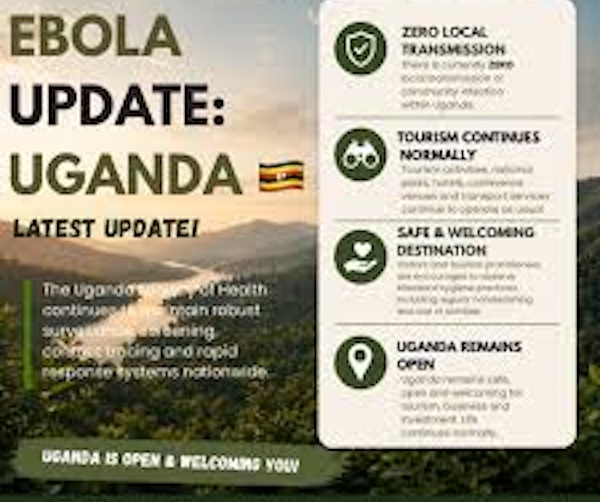
The Uganda Tourism Board has reassured travelers, tourism stakeholders, and the international community that Uganda remains safe and open for tourism despite recent media reports concerning Ebola cases linked to the Democratic Republic of the Congo.
According to the statement, Uganda has registered two isolated imported Ebola cases involving Congolese nationals who entered the country from the DRC. One patient sadly passed away and has since been repatriated, while the second is currently receiving treatment under the supervision of the Ministry of Health Uganda.
Authorities emphasized that there is currently zero local transmission or community infection within Uganda, a key indicator that the situation remains contained and under control.
Strong national response systems in place
The Ministry of Health continues to maintain robust surveillance systems across the country, including screening at points of entry, contact tracing, and rapid response mechanisms designed to quickly detect and manage any potential cases.
Uganda’s public health authorities noted that the country has extensive experience in managing Ebola outbreaks and other epidemic threats, a factor that strengthens its preparedness and response capacity.
Tourism and daily life remain normal
Despite the isolated imported cases, all tourism activities across Uganda remain fully operational. National parks, hotels, conference venues, and transport services continue to function without disruption.
The Uganda Tourism Board has encouraged visitors and tourism practitioners to continue observing standard hygiene practices, including regular handwashing and the use of sanitizers, while enjoying the country’s wide range of tourism experiences.
Uganda remains open and welcoming
Authorities reiterated that Uganda remains safe, open, and welcoming for tourism, business, and investment. They emphasized that daily life continues normally across the country, with no restrictions affecting travel or tourism operations.
The reassurance comes as Uganda continues to position itself as a stable and resilient destination in the region, even amid health concerns in neighboring countries.